Consequence Routing TTRPGs: When Getting Stronger Doesn’t Make You Safer
This is part of my ongoing series on system structure and pressure models—see also: Horror TTRPGs: The Rules Are the Monster)
This post isn’t about what deadly games look like, it’s about how TTRPG risk and reward design works at the system level. When people hear “deadly TTRPG,” they often picture fragile characters, brutal damage, and enemies that can kill you in one hit. So, a game where a goblin one-shots a novice adventurer qualifies, right? Nope. In most traditional and Old School games, once players get more hit points, better gear, or hire help, the goblin stops being a real threat. The system hasn’t preserved danger, it just delays when you can ignore it, eventually shifting into a heroic power curve where old risks stop mattering.
As in my previous pieces, this analysis is predictive and offers a blueprint: if you want to build a consequence routing TTRPG, these are the bones you must have in place. If you’re missing one, you can predict exactly where the system will fail, or where you have deliberately chosen to let it fail in order to support a different kind of play.
Here’s the key question: If you took away all the artwork, cut out every bit of fiction, and stripped away the GM’s narration, would the mechanics alone still make you feel the genre?
Once again, tone and setting are only half the game. They matter but they sit on top of an engine, and if that engine doesn’t enforce the premise then the GM has to. In a consequence routing system, survival doesn’t wipe the slate clean. If you avoid a killing blow, the system doesn’t see it as a simple win; the danger turns into something that still affects you later. Risk isn’t reduced or erased, it’s retained and rerouted. The moment players find a way to resolve consequences cleanly, the entanglement collapses. A true consequence routing system is one where getting better does not make you safer. It gives you more ways to navigate risk, but never a way to leave it behind. That’s the test.
Most TTRPGs run on a heroic pressure model where setbacks are temporary, recovery restores baseline, and advancement widens your margins for error. Consequence routing systems completely refuse that contract. The question is what the system does with danger after you survive it.
Methodology
The four criteria that follow are the clear pattern that appears when you research what games enforce through their rules, not just their atmosphere. I surveyed systems across the last 50+ years of the hobby, going as far back as D&D 1st Edition. I identified the industry-wide threads that separate true consequence routing systems from games that just look highly lethal. What you’re reading is not my personal preference for what a CR should mean, it is a description of what this design structure has been doing for decades that no one has mapped before. I am presenting a tool that designers can use to make their games sustain consequence routing conditions over time.
The Four Structural Criteria
These criteria are about whether your system enforces consequence routing during sustained play. Miss one and you’re asking GMs to do the work your mechanics should be doing. To qualify, a game must meet all four; miss one and you’re looking at something that is likely running a heroic pressure model:
- You can’t erase consequences. When a player survives a threat, does the game make sure that risk still matters somewhere else? In CR systems danger doesn’t vanish when you succeed, it just changes form. You might avoid damage, but the cost shows up as something else: a strained relationship, a lost resource, a new faction problem, or a lingering condition.
- If a consequence stays, it needs to matter. Do lasting effects actually change what your character can do? CR systems don’t allow for ‘flavor scars’. If you keep something on your sheet—like an injury, or a damaged reputation—it should affect your future choices, costs, or options. It also needs to be more than a debuff: if it doesn’t force you to act differently later, it’s just decoration.
- You can’t dump everything into one safe place. Is there any single mechanic that ends up absorbing risk without real tradeoffs? Many systems end up with a main safety net like hit points, wealth, or a recovery rule that soaks up consequences until they stop mattering. CR systems don’t allow that. No single resource should be able neutralize what the game throws at you. Buffers can exist, but they have to break down, convert into new problems, or expose you somewhere else.
- Getting better doesn’t make you safer. Does advancement reduce the danger of earlier threats? This is core. Improvement should never take risk out of the game, only just change how you deal with it. You might get more consistent, gain more options, or get better information, but you never get a bigger safety net.
Mastery doesn’t mean escaping the web of consequences; it means you gain the tools to navigate a much denser, more complex web.
The Consequence Routing Engine
Unlike the previous genres I’ve discussed (Grimdark, Heroic, Survival, Horror) consequence routing systems work very differently. They don’t really run on escalation or collapse, instead they operate as a closed system of risk: you can’t get rid of danger by getting stronger, so the game never turns into rising heroism or eventual breakdown. You just move sideways through a web of consequences that never fully clears.
The main idea is simple: you face a problem → you deal with it → the risk is routed elsewhere → it shows up again in a new form.
As you keep playing, the game doesn’t just get harder or easier: it starts to feel more dense. Instead of facing one-off problems, you start managing a web of connected consequences. Every choice you make adds more layers, and every win leaves something behind that you still have to deal with. The system doesn’t push you up or down, it just makes the world feel more packed with things to handle. This is what separates CR systems from other pressure models:
- Heroic systems: setbacks are absorbed, recovered from, and converted into increased capability.
- Grimdark systems: continued engagement erodes stability and identity over time.
- Horror systems: exposure corrupts perception, agency, or selfhood.
- Consequence Routing systems: when you deal with a risk you don’t get rid of it. It just sticks around in a new form.
Instead of trying to survive as things get tougher, you’re always working through the same amount of risk. It never goes away, no matter how long you play.
The main design challenge is managing throughput instead of accumulation. In a CR system you don’t need to keep adding consequences, just make sure that when one consequence ends it leads to another. For example, a wound might heal but leave a debt, or solving a faction problem could reveal a new issue. This way, the web of consequences stays active without growing out of control.
This leads to a clear design rule: whenever a consequence in your game ends, create a way for it to turn into something new. Instead of piling up, each consequence changes form.
If consequences end without leading to anything new, players will eventually clear everything and the system will drift back into standard heroic play. If consequences only build up without changing, the web gets too complicated and game masters may start removing things to keep the game running, which breaks the system. Managing throughput keeps the web of consequences full, manageable, and lasting.
Why Would People Play These Games
If advancement doesn’t make your character safer, what is the point of playing a long-term campaign? For players that like consequence routing systems, that is the appeal. Traditional heroic games use vertical escalation as the primary reward: you graduate from goblins to ogres to dragons. But for some players outgrowing the world makes it feel hollow. They don’t want the world to become less threatening, they want their decisions to matter more.
Over time it’s not your toughness that grows, but your skill. You get better at reading situations, predicting consequences, and deciding which risks you can afford to carry. As you advance, you gain more tools rather than more protection. A bad result doesn’t go away, it becomes part of the world you still have to navigate. Play becomes less about removing obstacles and more about moving through a space that remembers what you’ve done.
CR systems attract players who want their decisions to accumulate rather than their characters to escalate. If you’re the kind of player who finds meaning in a world that pushes back permanently, this is your engine. If you need the reward of outgrowing yesterday’s threats, you’re going to find consequence routing low-key exhausting. It’s worth noting that pure CR systems have an unusually committed player base, the kind that will run the same campaign for years exactly because the world keeps mattering.
Consequence Routing Games
Pure CR systems are rare because they require designers to block every path to safety while still keeping play functional and engaging. Instead of letting players outgrow danger or collapse under it, these games force risk to persist and mutate, turning successes into a new configuration of problems. These are the only games I could find that fully enforce that boundary:
Mausritter (2020, Isaac Williams)
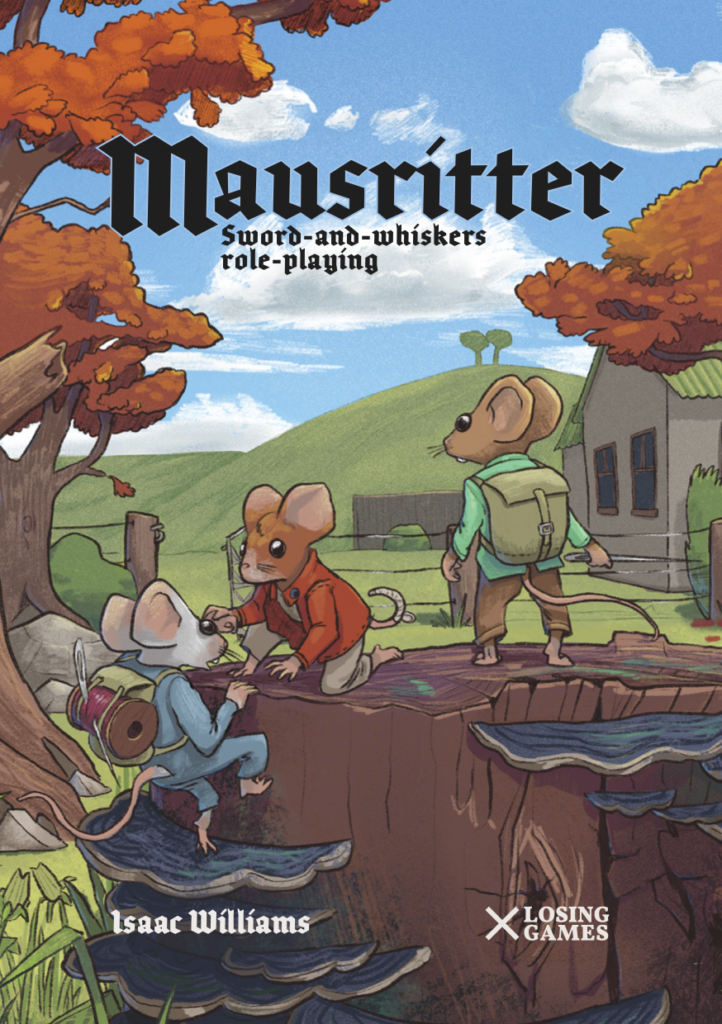
The Ennie-winning Mausritter is a game about small, vulnerable mice surviving in a dangerous, overgrown world: scavenging ruins, dealing with predators, and navigating fragile communities. You’re not becoming a hero who outgrows threats; you stay small in a world that never stops being lethal. That premise is backed by mechanics that turn danger into a physical, limited economy.
Everything your character carries—gear, treasure, and injuries—takes up space. When you get hurt, you lose more than hit points; you also gain condition cards like Injured or Afraid, each blocking an inventory slot. That forces immediate tradeoffs. To keep functioning, you have to drop something: supplies, tools, or loot you were counting on.
That structure blocks any “safe place” to store risk. Your inventory is the buffer, and it’s always under pressure. Surviving a problem doesn’t clear it, it reshapes what you can carry forward. Even growth follows that pattern. Recruiting mercenary mice might seem like buying a safety net, but it also multiplies your vulnerability. Hirelings demand wages, consume food, and require morale saves under stress to prevent them from fleeing. The system never lets consequences disappear; it keeps turning them into new constraints you have to live with.
Try it with: the boxed set has everything you need.
Ironsworn/Starforged (2018/2022, Shawn Tomkin)
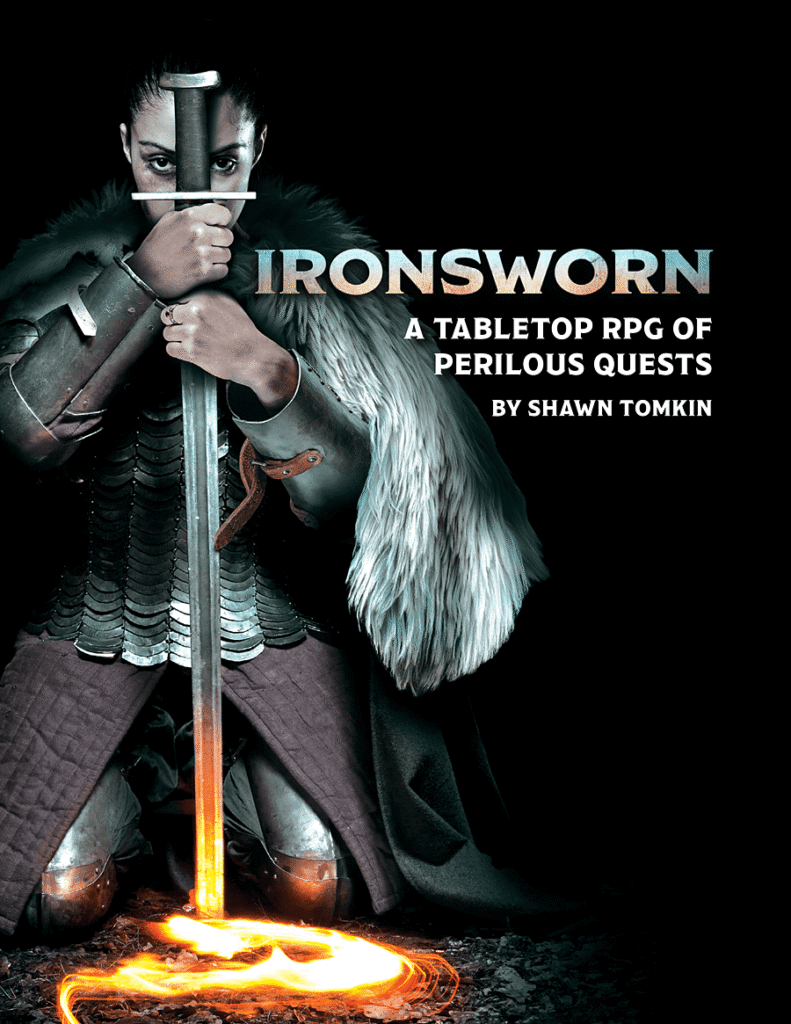
Ironsworn and its sci-fi counterpart, Starforged, are built around characters swearing vows in a harsh, persistent world. Advancement doesn’t come from becoming harder to kill, it comes from gaining new approaches and more control over how you engage with problems.
Mausritter keeps things balanced by limiting what you can carry, but Ironsworn uses strict rules instead. The main feature is Momentum. You build up Momentum to get past bad rolls or avoid quick setbacks, but once its used your Momentum resets and you’re at risk again. It’s not a lasting safety net, just a short-term tool that changes how you manage risk. Failures do more than stop your progress, because the game brings consequences back into play with the “Pay the Price” move, which makes you lose an advantage, take on stress, or deal with new threats.
You might find stability for a moment, but every action in the game comes with a cost. Mastery isn’t about being safe, it’s about learning to handle ongoing challenges. The game doesn’t let you take over the world. Instead, it asks how much you’re willing to give up to keep your promises.
Try it with: both books have everything you need. In fact I discuss Starforged in my post on one-book RPGs.
Dogs in the Vineyard (2004, Vincent Baker)
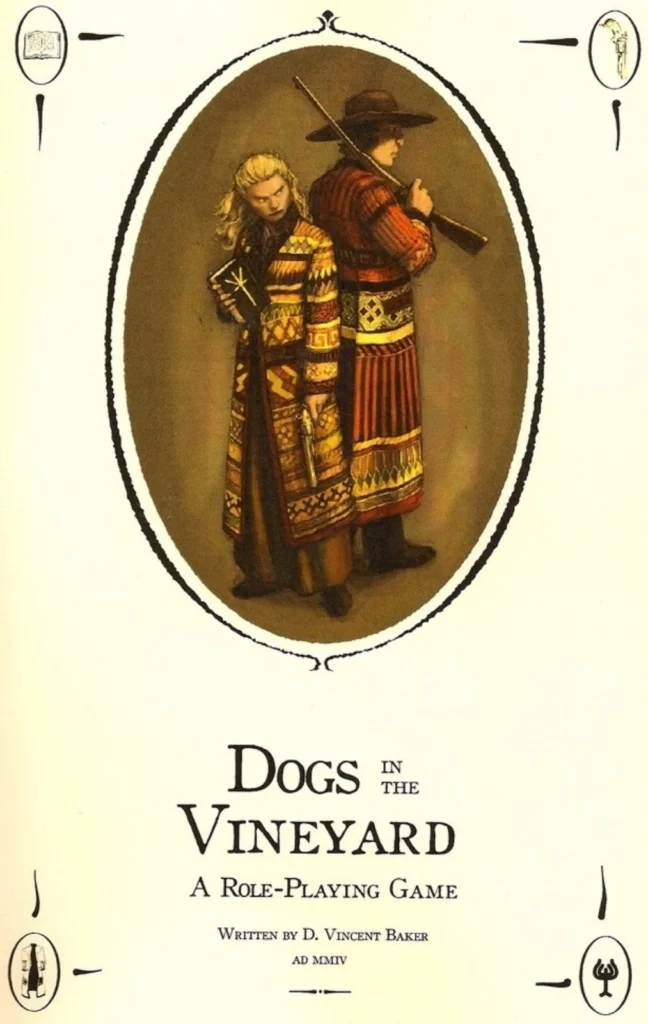
Dogs in the Vineyard is about young religious judges riding from town to town, settling disputes, rooting out sin, and deciding what justice looks like when the community is already breaking. Most conflicts start small—questions, arguments, social pressure—but the system lets you escalate step by step, from talking to threats, to fists, to guns.
That escalation is the core of its consequence routing. If you’re losing, you can always bring in more dice by raising the stakes. Pull a weapon, invoke authority, push harder and you can usually win. But you don’t get that for free. Every hit you take becomes Fallout, and Fallout doesn’t just disappear. It leads to lasting traits, injuries, and changes in who your character is.
So the trade is constant: you can get the outcome you want, but you decide what it costs you to get there. Winning a conflict by escalating to violence means carrying that violence forward as part of your character. Over time, your sheet fills with the consequences of your decisions: what you chose to do, how far you were willing to go, and who you became in the process. The system never really lets you “win clean.” It just makes you choose where the consequences land, and then asks you to live with them.
DitV is out of print, but was adapted into DOGS. It’s now a generic system and can be used in any game where you solve mysteries, settle disputes, and make moral or ethical decisions.
Delta Green (1997, 2016, Detwiler/Glancy/Tynes)
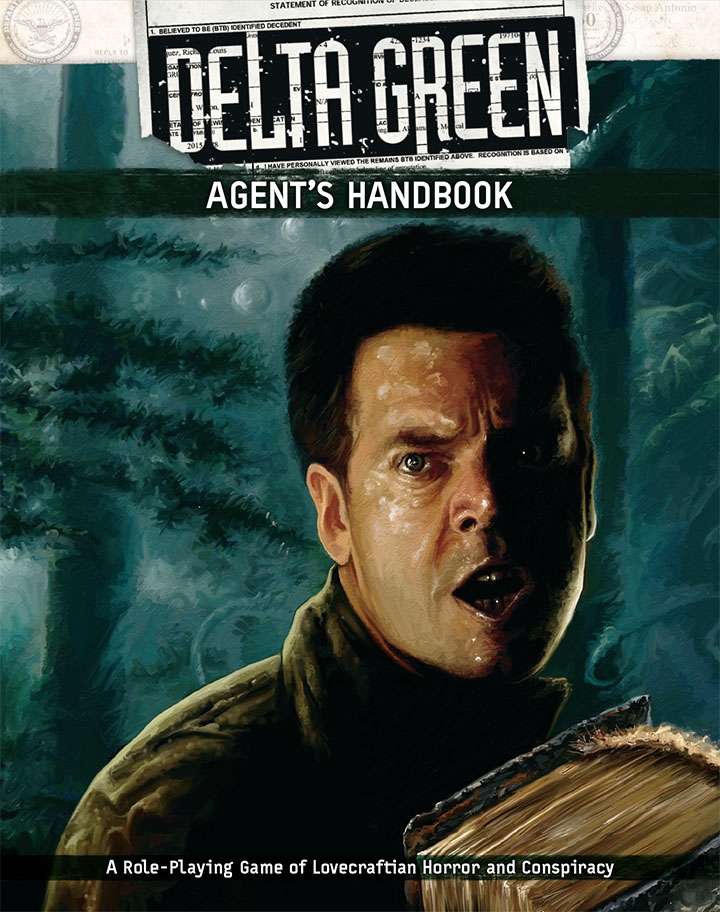
Delta Green is a horror system (I featured it in my post on horror) where your Sanity is always slipping away, but it also adds a clever extra layer with its routing mechanic. When something traumatic happens, you can protect yourself by shifting some of that stress onto your Bonds, which are your relationships with family, friends, and the things that keep you grounded. At first this seems like a safety valve, but in reality it’s a trade-off. You stay functional for now, but you’re slowly wearing down the support network you rely on to survive. Over time, those relationships weaken, fall apart, or even become problems, which makes it harder to handle stress in the future.
The key point is that the system never lets you escape without consequences. Even if you avoid the worst outcome something else still suffers, and that continues to matter. It’s not a simple system where everything balances out: Sanity still trends downward, and veteran agents eventually adapt and become numb to the horror rather than perfectly rerouting it. This shows how consequences can shift into new, lasting problems. DG shows us that a secondary pressure model can be embedded within a primary one without changing the dominant trajectory.
Try it with: Need to Know, the free, Ennie-winning starter rulebook.
Where Risk Stops Routing (And Why That Matters)
Understanding where and why games fail the criteria is as useful as knowing which pass, because it reveals what players actually want versus what consequence routing systems deliver.
Dungeons & Dragons (1st edition and OSR games) seems deadly at low levels because even simple threats can kill you. But the game is actually built around players overcoming danger by gaining hit points, better gear, and more party members. Criterion 4 fails because as characters advance earlier threats matter less, and Criterion 1 and 3 follow since those threats eventually stop having real consequences.
Blades in the Dark fails C4: as crews progress, they earn enough Coin and downtime actions to clear Stress and lower Heat more easily. This financial buffer lets them absorb more fallout, so the system’s impact fades over time. It’s the clearest example of a game that routes consequences well, but can’t prevent its own advancement model from gradually buying them off.
Spire: The City Must Fall and Heart: The City Beneath both start with a great system that uses several stress tracks, along with Fallout. The system also moves risk to different parts of the character, so players have to keep deciding where the costs go and how they build up. At lower and middle levels this works great. However, criterion 4 fails because as characters advance they gain powerful narrative tools and special effects that can prevent or override consequences.
Warhammer Fantasy Roleplay might seem like it uses a CR system because injuries and critical wounds can last for a long time, or even permanently. However it doesn’t meet Criterion 2, since this only subtracts from your abilities instead of creating new challenges or choices. A torn muscle just stays as a debuff, reducing what you can do. WFRP is actually a grimdark game (which I cover in my Grimdark post), often leading to a death spiral instead of a system that redirects consequences in new ways.
Forbidden Lands fails C3 as players start building a stronghold, the system changes. When your base starts producing food and income, it absorbs the risk. Just sleeping in a stronghold allows you to completely bypass the wilderness mishap rolls, for example. FL starts as a wilderness survival game, but later becomes more of a domain-style campaign.
Conclusion
Consequence routing isn’t about making games cruel, it’s about refusing to let risk evaporate. Most “deadly” systems are actually heroic or survival engines with more bite at first. They start out volatile, but soon add ways for players to absorb, outgrow, or contain danger until it’s no longer a threat. A CR system doesn’t give you that escape, it just keeps asking where the risk will show up next, not how it goes away.
These four criteria set the boundaries for a CR system. If a game lets you erase consequences, store them safely in one place, or outgrow them as you advance, it isn’t routing consequences. Instead, it’s moving into a different kind of pressure system. If a game claims that getting better doesn’t make you safer, its mechanics have to enforce that constraint over time.
For designers, the real question isn’t “Does this feel unforgiving?” It’s “What happens to risk across sustained play?” If every success still leaves something active behind—whether in relationships, resources, factions, or positioning—you’re working with a CR system. If risk can be wiped away, stored in a single resource or left behind as players progress, then it’s not.
I am greatly indebted to Reddit user htp-di-nsw for the initial idea that led to me investigating this kind of ttrpg system.
And as always, if you know a game that meets the criteria and hasn’t been mentioned here, I’d really like to hear about it.
For those interested, my next post is: Social Enmeshment TTRPGs: You Think Social Mechanics Are Flavor. They Aren’t.
Want this kind of structural analysis applied to your system? Request a Structural Audit
You’ll get a written diagnosis of where your mechanics create unintended pressure, plus concrete fixes aligned to your intended play experience.
If you’d like notifications for future posts, subscribe below.