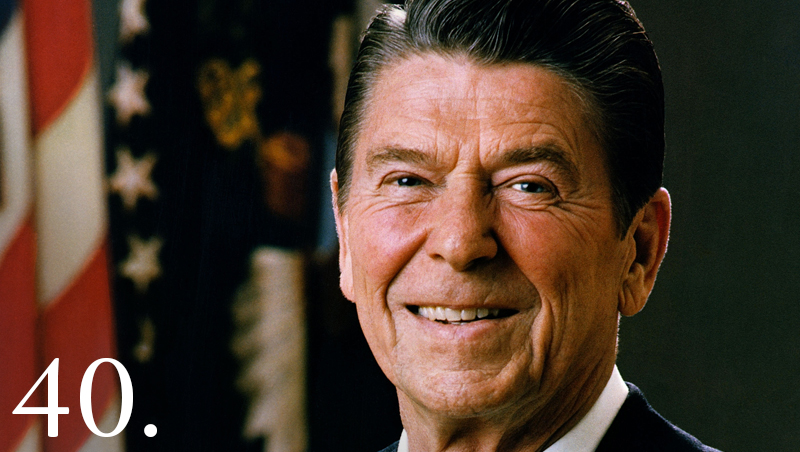
Ronald Reagan’s Presidency and Legacy
Read Part 1 Here
By January 1981, Reagan’s beliefs were firmly set. Earlier I described how he spent thirty years gathering experiences, frustrations, and ideas that shaped his philosophy. He saw government as more of a problem than a solution, and he trusted that free people, open markets, and voluntary groups could handle challenges better than far-off officials. To him, both communism and big government threatened individual freedom in similar ways.
Now he was president. The real test was how those beliefs would hold up in practice. The truth is more complex than most people admit. Reagan achieved some of his biggest successes when events matched his vision. At other times, he quietly set that vision aside. Some of his most lasting failures grew directly from the same beliefs that produced his greatest achievements. This is the Reagan I’m trying to place accurately.
We’d already seen hints of this in Sacramento. As governor, Reagan raised taxes when necessary, approved one of the country’s most liberal abortion laws, and built an environmental record many Democrats would have been proud of. His philosophy was the public face, but being pragmatic was often what happened behind closed doors.
Restoring Confidence
The first thing Reagan accomplished is easy to miss because it wasn’t a policy. It was a change in mood.
By 1980, the United States had absorbed more than a decade of institutional shocks. Vietnam had broken trust in American power, and Watergate had broken trust in political leadership. Inflation, economic stagnation, and the Iran hostage crisis left many Americans feeling like the country was just drifting.
Reagan arrived with exactly the right temperament for that moment. He really believed America’s best days were still ahead, and he could communicate that belief in a way that felt natural rather than rehearsed. This is what the “Great Communicator” label actually means — he understood that presidents don’t just manage government, they tell the country stories about itself. After years of scandal and self-doubt, he offered Americans a story they were eager to hear: that the country’s decline was neither inevitable nor permanent. Gallup polling captures it plainly: 53% of Americans were optimistic about the country’s future in 1979, and by 1991 that number was 75%.
Whatever people think of the policies that followed, that achievement was real.
Breaking Stagflation
The second achievement was all about the changes in the country’s economic structure. Reagan inherited something economists had struggled to even name: stagnant growth combined with high inflation. By 1980, inflation was running at 12.5% annually, interest rates were crushing small businesses and homeowners, and public confidence in economic management had largely collapsed.
Reagan didn’t solve this alone. The Federal Reserve under Paul Volcker played a central role, deliberately inducing a recession to stop inflation. Reagan made it possible for this tough approach to continue by shaping the political climate. He absorbed the short-term damage, pushed through the largest tax cut in American history, and by the mid-1980s inflation had dropped and the economy was growing again.
The long-term impact was even more important than the quick recovery. Reagan changed the basic ideas behind how the U.S. government manages the economy, including how much the government can take from people’s paychecks and the balance between private markets and public investment. Before Reagan, both political parties generally accepted progressive taxation. After his presidency, that agreement disappeared. Every debate about taxes and spending since then has happened in a landscape he changed.
The Cold War Endgame
This was Reagan’s greatest achievement, but also his most paradoxical. The man who called the Soviet Union an “evil empire” in 1983, when the two superpowers were closer to nuclear war than any point since the Cuban Missile Crisis, was the same man who negotiated the INF Treaty, eliminated an entire class of nuclear weapons, and laid the groundwork for a peaceful end to the Cold War.
Reagan saw something that his own hawks and foreign policy realists like Nixon and Kissinger mostly missed: Mikhail Gorbachev was a different kind of Soviet leader, someone he could trust as a negotiating partner. Reagan followed this path despite strong resistance from his Defense Department, conservative allies, and establishment figures who thought that relying on personal trust instead of deterrence alone was dangerously naive.
But he didn’t do it alone. Gorbachev brought his own reformist mindset to the table, his own recognition that the Soviet system was failing from within, and had his own hardliners to face. The end of the Cold War required both leaders to move toward each other at the same time, despite resistance on both sides. Reagan deserves enormous credit for recognizing the opportunity and having the instinct to act, but he does not deserve all the credit.
Iwan Morgan calls this perhaps the greatest achievement of any American president since World War II and it’s hard to disagree, especially since Reagan succeeded by moving away from his own ideology instead of sticking to it.
The Hinge
Before we continue, it’s worth pointing out a pattern in all three of these achievements.
Each of Reagan’s biggest wins required him to override his own philosophy rather than follow it. Restoring confidence required genuine human warmth that transcended ideology. Breaking stagflation required sustaining a brutally painful strategy that hurt millions of Americans in the short term. The Cold War breakthrough required negotiating with the enemy he’d spent decades demonizing, over the objections of his own hawks. Reagan the pragmatist kept overruling Reagan the speechmaker. That’s what made the achievements possible.
When we turn to the failures, the opposite is true. These are the places where the anti-government approach ran unchecked — where the override switch stayed off. The consequences, in several cases, we are still dealing with today.
The Deficit Paradox
Reagan came to Washington promising to cut government. But he couldn’t do it, not really. The liberal state was too established, its programs too popular, and the political cost of dismantling them was too high. Social Security, Medicare, and the core parts of the New Deal and Great Society all remained.
But something else happened. The 1981 tax cuts slashed federal revenue, military spending surged, and the deficit exploded. When Reagan took office the national debt stood at roughly $994 billion — a stack of $1,000 bills about 67 miles high, as he himself liked to say. When he left, it was nearly $2.7 trillion and that stack was now over 200 miles high.
This is the paradox: it may have been Reagan’s most lasting domestic legacy, even if it was not intentional. The growing debt eventually achieved what direct cuts could not. By starving the federal government of revenue while ramping up defense spending, Reagan made it much harder for future leaders to expand progressive programs. Now, every debate about growing government programs faces the wall of existing debt, so the cuts Reagan could not make the debt accomplished for him, gradually, over generations.
Morgan calls this “Reagan’s revenge on the liberal state he could not destroy.” Dick Cheney later confirmed this thinking as Vice President, famously saying, “Reagan proved deficits don’t matter.” He meant that deficits do not matter politically in the short term. What he missed is that they matter a great deal for everyone who comes after.
Who the Prosperity Actually Reached
The economic recovery in the 1980s was real, but it did not reach everyone equally, and the gap between those who benefited and those who did not came directly from Reagan’s policies.
His 1981 tax cuts mostly benefited people with higher incomes (supply-side economics), and deregulating financial markets shifted the economy to favor capital instead of labor. Reagan’s decision to fire the air traffic controllers in 1981 sent a clear message that bargaining power was moving away from workers; this change grew stronger over the years, and it started a split in incomes that still hasn’t been fixed. Executive pay soared, while the average workers’ wages crawled.
Deregulation had serious long-term effects. The Garn-St Germain Act of 1982 gutted oversight of the savings-and-loan industry. When Reagan signed it he said, “I think we hit the jackpot,” but the result was reckless lending, widespread fraud, and a $124 billion taxpayer bailout, one of the largest in American history. When the industry’s regulator warned the administration and asked for stronger supervision, he was fired.
But the S&L scandal was only a symptom. The bigger change was the financialization of the American economy, as corporate America shifted its focus from manufacturing and workers to shareholder returns. Reagan’s SEC made this possible by legalizing share buybacks in 1982, which moved corporate money away from wages and long-term investment and toward financial engineering. This helps explain why the recovery was so uneven. In 1983, Reagan wanted “a country where someone can always get rich.” He achieved that but in the years that followed, greed and corruption grew together. Ivan Boesky’s famous line, “greed is healthy,” was a reflection of its culture.
This connects directly to Part 1. Reagan genuinely believed success was available to any American willing to work, because it had always been available to him. What his background made nearly impossible to see was that the structural barriers facing poor and non-white Americans weren’t the kind that tax cuts and deregulation could remove. The prosperity was real, “Morning in America” wasn’t fiction, it just reached far fewer people than the ads claimed.
The Empathy Gap
There’s a deeper pattern showing up now, and it’s less about economics than perception.
Reagan’s worldview depended on what he could see when he looked at the country, in other words his optimism determined what he noticed and what he missed. For people who were doing well or close enough to benefit from economic growth, his story about America made sense. But for those outside that group, it often did not.
The gap was most obvious when it came race, poverty, and AIDS. His welfare politics was very suspicious of dependency, and his law-and-order approach made the system more punitive, with effects that lasted long after he left office. On AIDS, the federal response was too slow and too detached for a crisis already killing thousands — Reagan didn’t even publicly say the word “AIDS” until 1987, six years into the epidemic and some 20,000 deaths later. The idea of a “shining city on a hill” was powerful, but many Americans were left out. That’s the empathy gap.
Iran-Contra and the Executive Overreach Precedent
People often see Iran-Contra as a simple scandal: the administration was caught doing something illegal, there was embarrassment, and then everyone moved on. But that view misses what really happened and why it still matters.
The basic facts are Reagan’s National Security Council secretly sold arms to Iran, and used the proceeds to illegally fund Nicaraguan Contra rebels after Congress had clearly banned it. The officials in charge, like Oliver North, truly believed their actions were justified because they thought their cause was right. When Congress blocked their efforts to fight communism, they ignored Congress. They believed that having good intentions made it acceptable to break the law. This was not just random corruption, it was the clearest example of a belief that the right goals were more important than the balance of power meant to keep them in check.
That way of thinking did not end with the scandal. Dick Cheney, a Republican congressman at the time, defended the administration’s actions in the minority Iran-Contra report. He argued for a broad view of executive power that could ignore limits set by Congress when it came to “national security.” Fifteen years later, as Vice President after 9/11, Cheney used that same idea on a dramatically larger scale. Reagan set the precedent and later, the neoconservatives drove a truck through it.
Cold War Casualties
Reagan’s anti-communism produced his greatest achievement. Applied to the developing world, though, the same worldview produced a much darker record.
The thinking was straightforward: any regime fighting Marxism deserved support, regardless of how it treated its own people. In El Salvador and Guatemala, U.S.-backed regimes carried out mass killings. In Afghanistan, CIA weapons went to Mujahideen fighters who later became the Taliban. In Iraq, the administration backed Saddam Hussein during the Iran-Iraq war and looked the other way when he used chemical weapons. Reagan didn’t start these conflicts, but his administration’s willingness to subordinate human rights for Cold War goals helped sustain regimes and armed factions whose consequences Americans are still living with today.
What makes this particularly striking to me is the contrast with the Soviet breakthrough, because Reagan was willing to override his anti-communism when the moment called for it. In the developing world, though, he was much less flexible. The people affected were poorer, farther away, and less visible to Americans. The Cold War mindset that helped solve some problems often made others harder to see. The United States won the Cold War, but the costs of the way it was fought are still being felt today.
So Where Does That Leave Us?
Looking back over everything, I keep noticing how uneven the record is.
Reagan doesn’t fit into the usual categories. He’s not the conservative savior his supporters claim, and he’s not the cause of decline his critics argue. The facts point to something more complex: a president whose big successes and failures both came from the same core beliefs.
To me what stands out isn’t just Reagan’s beliefs, but how deeply he held them. He didn’t increase deficits to hurt the liberal state on purpose, he didn’t support harsh regimes because he enjoyed it, he didn’t ignore AIDS out of malice. He truly believed free markets would fix unfairness, that fighting communism was a moral duty, and that America’s best days were still to come. This strong sincerity made his ideas persuasive, widely accepted, and long-lasting.
Modern conservatism still speaks his vocabulary, it still claims his legacy, but it rarely reckons with the full record. To understand Reagan fully you have to consider all of these things together. It’s harder than just choosing a side, but it’s the only way the whole picture makes sense.