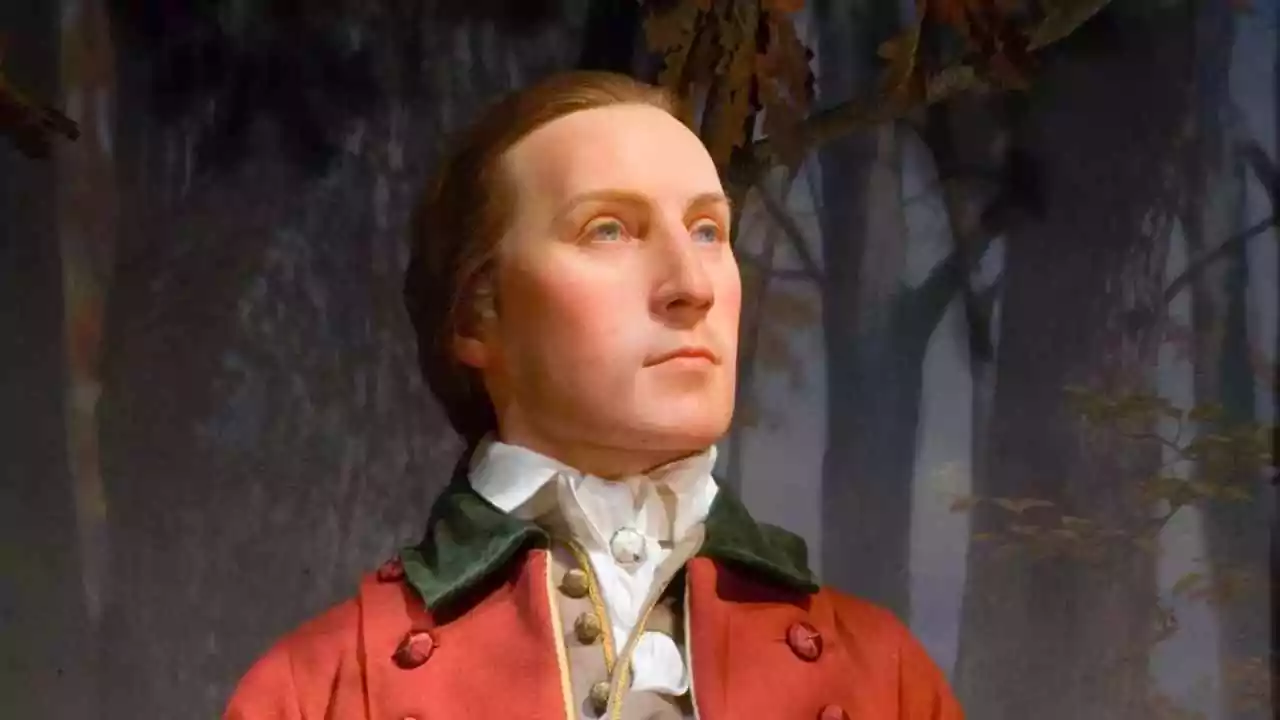
George Washington: The Formation of a President
Read Part Two Here
After reading and writing about Reagan, I realized there is a lot I don’t know about our Presidents. I decided to start at the beginning, with George Washington. I’ve always been interested in him, but he’s so often seen as a marble statue that it’s tough to tell the real person from the myth. We still talk about his stoicism, realism, and nation-building, but to truly understand him we have to reckon with how slavery shaped his world too. So I bought two biographies of Washington by Pulitzer-Prize winning writers. The first was Washington: A Life by Chernow, and the second was His Excellency by Ellis. As with my pieces about Reagan, my overriding goal here is to strip Washington down to his irreducible reality instead of reductive comfort. The traditional comfort of Washington is as a kind of marble demigod, where as the modern comfortable position is that he was a hypocritical slaveholder.
Here’s what I found: Washington became both a nation-builder and a strong defender of an unequal system. These were not separate parts of him. Throughout his life he repeatedly trusted disciplined authority, hierarchy, and the preservation of the larger order over demands that rose from below. That preference helped make him a realist, a capable leader, and eventually a nation-builder. But it also made him more willing to manage slavery, inequality, and other injustices than confront them at their full moral cost. His strengths and failures developed together in a Virginia world built on rank, property, authority, and slavery; a world he came to question, but never fully escaped.
The Ambitious Provincial
Washington wasn’t always stoic. He started out insecure and very ambitious—a younger son with only a small inheritance, no classical education and a desire for status, respect, and financial freedom that lasted his whole life. His early poems about “Poor Resistless Heart” and his awkward attempts to win over Betsy Fauntleroy show a young man still trying to find his place in society.
What drove him wasn’t a set of beliefs, but ambition. He joined the world of the Fairfaxes, Virginia’s most powerful family, who controlled over five million acres due to a royal grant. He wasn’t their equal, more of a protégé, and he took in their ideas about social hierarchy just like anyone takes in the values of the world they grow up in.
His ambition was never about wealth or comfort, it was always about status. In mid-1700s Virginia, being important meant having the power to command—over land, tenants, and eventually, the people he owned. The setbacks he faced as a young man, like being denied a British commission or being looked down on by General Braddock’s staff, didn’t turn him into a democrat. Instead, they made him want a top spot in a system he had no plans to change.
The Crucible of the Frontier
Washington’s political instincts hardened on the Virginia frontier between 1754 and 1759. He took part in the Battle of Jumonville Glen, oversaw the drawn-out violence at Fort Necessity, and saw British troops run away at Braddock’s defeat during the French and Indian War while his own Virginia soldiers stood firm. No university could have matched it.
But this isn’t just about George learning about freedom. The same events that taught him to stand up to the British also taught him to value strict obedience, harsh discipline, and strong control, and the mix was there from the beginning. When soldiers started deserting the Virginia Regiment he didn’t try to inspire them with patriotism. Instead he built a forty-foot gallows, hanged deserters in public to scare the others, and ordered thousands of lashes. He said this wasn’t cruelty, but the only way men on the edge of colonial society would learn.
As he grew more resistant to being ordered around by those above him, he also became more willing to enforce discipline on those below. Watching Braddock die because he used British tactics that didn’t fit American conditions taught Washington a hard lesson: rules that work in one place can be deadly in another. Washington rode right through that, having two horses shot out from under him and four bullets tear through his coat while coming out unscathed. That miracle deepened his belief in providential protection and his conviction that he was being preserved for a higher destiny. This experience made him a realist who understood the need to adapt and saw the difference between official authority and real power, which later informed his presidency. These qualities later made him a better commander than any British-trained officer in the Continental Army.
The Hinge of Self-Mastery
Self-mastery was at the center of Washington’s development. His famous self-control wasn’t just a personality trait; he worked hard to develop it as a political tool and made it his main guiding principle.
This is clearest in his relationship with Sally Fairfax, who was married to his closest patron. When he wrote to her about his feelings just before marrying Martha Custis, it wasn’t the beginning of an affair it was an act of self-control. He folded his feelings under the weight of ambition, decorum, and self-command. From then on his personal discipline and his public discipline developed side by side.
His letters sometimes show the sensitive man beneath the legend: embarrassed by the Society of the Cincinnati scandal, angry at insults to his honor, and keeping careful records of every debt as if being owed money was a personal slight. Still, his effort was real and had real effects. He came to believe that authority starts with self-control, and that belief shaped everything he did: his caution, his quiet approach, and his refusal to act rashly. It also made him prefer order over openness and feel more comfortable with hierarchy than with the new ideas about equality that the Revolution brought, which he found confusing.
It was also very clear to me Washington’s faith shaped his political views and strengthened his lifelong commitment to order, hierarchy, and self-control. He was a “lukewarm Episcopalian” who saw the church as a foundation for social stability and civic duty, not as a matter for public display. He avoided Communion, rarely mentioning Jesus Christ. Instead, he believed deeply and unsentimentally in “Providence.” This guiding force did more than protect him from danger, it also justified his remarkable rise in life. By seeing himself as part of a higher plan, Washington pushed himself to lead with discipline, attached chaplains to his regiments, framed military victories as heavenly favor, and masked his massive ambitions behind a posture of stoic, providential submission.
George Washington, Mount Vernon, and Slavery
When Washington married and took charge of Mount Vernon, he found his training ground for governance. Managing a massive plantation improved his skills in administration, long-term planning, and his belief that big organizations needed constant attention. The thousands of orders he wrote showed that he believed leaders need to know exactly what’s happening at every level.
But what was happening at the bottom was slavery.
By the time Washington retired from the presidency, the combined estates under his control held hundreds of enslaved men, women, and children. Managing them wasn’t just a side note in his life, it was a key part of who he became. He sold an enslaved man named Tom to the Caribbean for molasses and rum, treating him as just another commodity. He co-organized a lottery that gave away enslaved people as prizes, splitting up families. He placed ads in newspapers to catch runaways, just as he did with escaped indentured servants. His views on discipline, work, authority, and social distance were shaped every day by being in charge of people who had no legal way to resist him.
It’s true and well-documented that Washington eventually saw slavery as outdated, first economically and then morally. By the mid-1780s he privately supported gradual emancipation and decided not to buy any more enslaved people. He freed his own slaves in his will, making him the only major Founding Father to do so. These facts are important to any honest story about him, but they don’t erase the contradiction—they make it clearer. He knew slavery was wrong, understood it was wrong, and chose to manage it instead of facing it head-on because that’s exactly the approach his background had prepared him for.
The Imperial Crisis
The imperial crisis made Washington think beyond Virginia’s problems and focus on American politics as a whole. He wasn’t an early supporter of independence, nor was he someone who just needed the right words to be convinced. He stayed loyal to the empire until a series of personal and political setbacks changed his mind: fights over western land, trouble with London creditors, the Royal Proclamation of 1763 blocking his land claims, the Stamp Act a couple of years later, and the Townshend Duties. The final straw came in the winter of 1768–69, when Parliament threatened to try colonial resisters for treason in London, making the inequality of colonial status impossible to ignore.
As Washington moved toward resistance, another contrast became clearer. He was strongly committed to American freedom, but not to equality. He wanted independence, but with strong leadership, stable authority, and complete freedom from British control. The Society of the Cincinnati, a group of Continental officers accused of acting like British aristocrats, made this clear.
Washington’s reaction to the Cincinnati scandal was complicated. He said he would resign if the hereditary membership rules were not removed and even thought about ending the society altogether. Still, he did not agree with the critics, calling their objections “hyperbolic prejudices conjured up by designing men.” The scandal made him deal with a political issue, but it did not change his views. He believed the Revolution had ended monarchy and British rule, but not the world of rank and earned distinction that had helped him succeed. The uproar over the Cincinnati was probably the first moment he recognized that not everyone agreed.
The Education of the Revolution
The Revolutionary War finished Washington’s political education. The war showed him that idealizing citizen militias was risky, that focusing only on local interests could be deadly, and that high-minded principles meant nothing without real power to support them. He was willing to hang men who fell asleep on guard duty and ordered lashes for soldiers whose main offense swearing, drinking, and desertion.
Washington showed the same reliance on force in his approach to the war. In 1779, wanting to stop frontier raids by Native Americans, he sent four thousand troops into Iroquois/Haudenosaunee territory in what was later called the Sullivan-Clinton Expedition. He gave his officers clear and harsh orders: destroy their settlements completely and take as many prisoners as possible. The campaign destroyed at least twenty Indigenous towns and villages, causing lasting harm to the Six Nations. For Washington this was not random cruelty, it was a deliberate use of state power to secure the frontier and help America gain control over the western lands he had wanted since he was young.
This calculated use of force was matched by a strong political survival instinct within his own ranks. During the bleak winter of 1777–78, Washington faced his toughest internal challenge in the so-called “Conway Cabal”—less a conspiracy than a loose gossip network of critics wanting to replace him with Horatio Gates. When a leaked letter exposed the plotting, Washington avoided direct confrontation. He confronted the ringleaders with their own words, leaked the rumors, and let it be known he’d step aside without complaint, instantly draining the opposition’s momentum. The intrigue collapsed into groveling apologies and duels, proving Washington was a master political infighter who consolidated his authority through patience and cool self-control.
This is the main paradox: Washington fought against British abuse of power while creating a command system that many republicans found frightening. So deep was the army’s trust in his authority—and so deep was their frustration with a weak, bankrupt Continental Congress—that in May 1782, Colonel Lewis Nicola wrote Washington a letter suggesting the only way to secure the army’s grievances and stabilize the country was to establish a monarchy with Washington as its king. Washington’s rejection was fierce and final, stating it was highly offensive to his principles. This mix, strong leadership under civilian control, became the foundation of his approach to government. When he formally gave up his sword at Annapolis in 1783, it was a powerful gesture made all the more real by what he had privately turned down, stopping talk of a military monarchy for a generation.
But the same man who gave up his sword at Annapolis also, in the aftermath of Yorktown and again during the evacuation of New York, pushed fiercely to recover escaped slaves from the British. These two acts belong in the same paragraph because they aren’t contradictions that cancel each other out; they come from the same person, shaped by the same experiences and beliefs.
The Managed Contradiction
Washington’s background gave him the political mind needed to help found a republic. The faith, discipline, realism, and national vision he showed as president in 1789 weren’t just for show. He earned them through tough experiences on the frontier, military setbacks, running large operations, and years of practicing self-control. The examples he set—like civilian control, peaceful transfer of power, and putting the institution above personal gain—were some of the most important political achievements of the 1700s.
But the same background that gave him these strengths was always tied to hierarchy, coercion, and slavery. His self-mastery developed inside a world where mastery over other people was treated as ordinary. One was praised as virtue, the other depended on treating human beings as property. His nationalism wasn’t a democrat’s faith in self-government — it was a planter’s conviction that weak institutions meant chaos, and chaos put property, rank, and status at risk along with the union itself. His realism included a practical willingness to handle moral contradictions he would not pay the price to resolve.
He had seen the slavery issue nearly derail the Constitutional Convention. He knew slavery was wrong, supported its eventual end in private letters, and freed his own slaves in his will. But throughout his life, he made sure that the political system he was building would not be put at risk by directly challenging slavery.
The presidency didn’t create this conflict. It gave Washington the opportunity to govern through it, at the head of a republic whose founding documents promised equality but whose economy depended on slavery. He managed this tension with extraordinary skill. That skill and the order it sustained came at a cost that he managed, that others paid, and that the nation did not settle for another eighty years.
My next post will be analyzing how he used his principles and political philosophy as our first President. Read it right here.