The 25-Foot Arc: A Geometric Solution to NBA Monotony
The NBA 5-out Offense Problem
The NBA’s current 5-out equilibrium maximizes offensive efficiency but has gutted tactical variance. League-average pace has hit a 30-year high at roughly 102 possessions per 48 minutes, but about 85% of possessions still resolve in the halfcourt through nearly identical geometric actions.
The result is a game that is statistically fast but visually flat. Team identities that once differentiated contenders now depend less on structural approach and more on personnel quality. This is not a coincidental convergence. The current geometry selects a single offensive solution, making structural differentiation competitively unviable rather than just unfashionable.
Legendary three-point shooter Ray Allen recently lamented that the league has “lost the mid-range game” and that offenses too often amount to “first shoot threes, second shoot threes, third shoot threes.” His critique wasn’t of three-point shooting itself, but of a league that has increasingly converged on a single offensive play style.
This homogenization has coincided with a decade-long decline in national viewership. Primetime audiences have nearly halved since 2012–13, and NBA telecasts have continued to lose absolute viewers, not just market share. Meanwhile, league-average defensive rating has climbed from roughly 107 points per 100 possessions in the 2010s to 112.5 in the 2020s. Defensive optimization has eroded alongside offensive homogenization. Viewership decline is overdetermined, with “load management” and shifting media habits playing real roles, but offensive homogenization is a structural contributor that is worth isolating and addressing: I propose a single geometric change that breaks the 5-out equilibrium of today’s NBA and restores the conditions for strategic diversity.
The Geometric Fix: A Uniform 25-Foot Constraint
Ironically, the fix requires returning to the shot’s origin. When the American Basketball League first introduced the three-pointer in 1961, commissioner Abe Saperstein set the line at 25 feet purely as a promotional gimmick. Sixty-five years later, that gimmick has become the mechanical antidote to an over-optimized game.
The intervention is a single geometric change: a uniform 25-foot three-point arc.
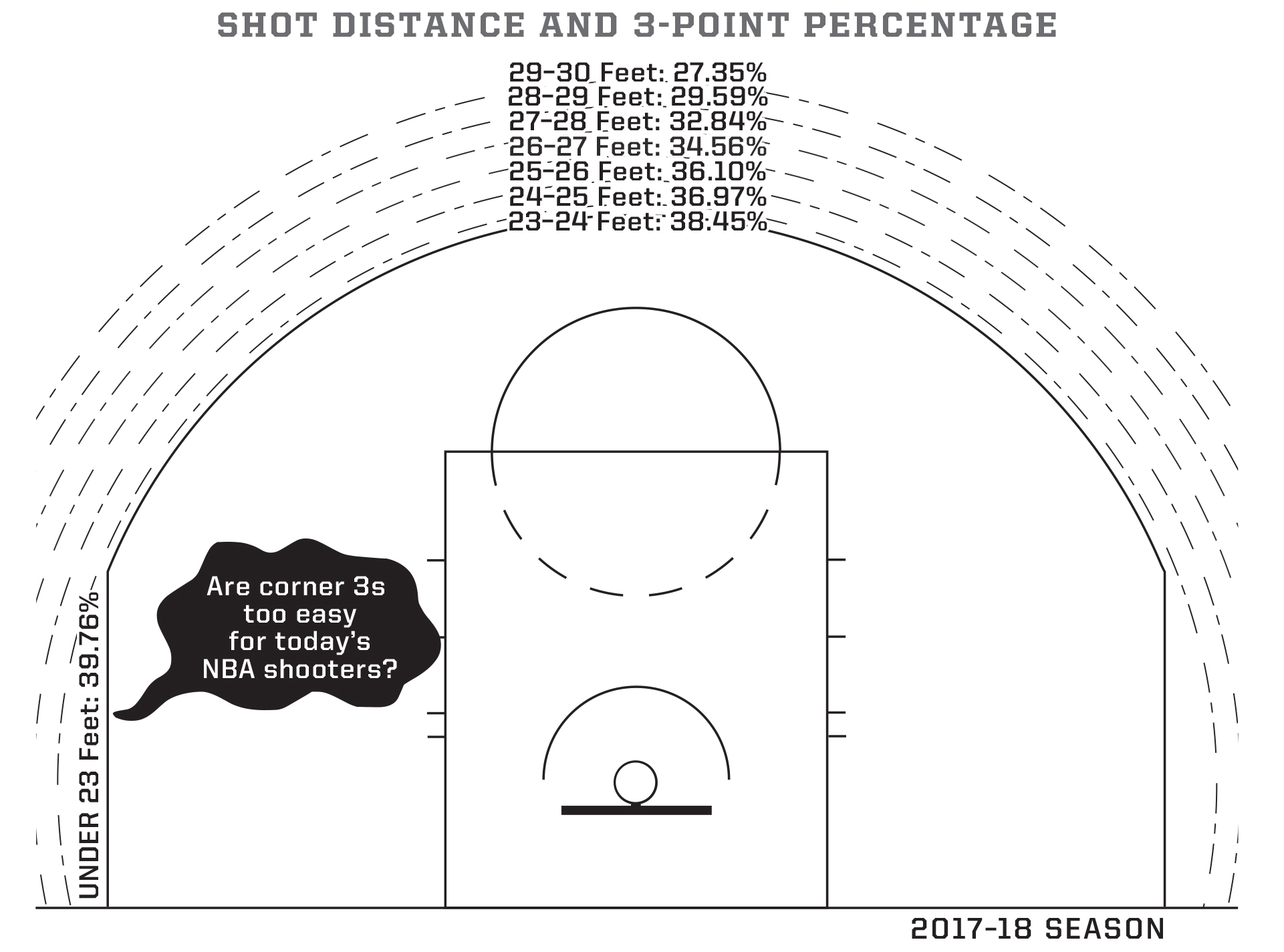
Because the court is exactly 50 feet wide, a 25-foot arc intersects the sidelines. This eliminates the corner three by physical constraint, not prohibition. It reprices the game’s cheapest spacing outlet without adding any enforcement complexity.
Removing the corner three doesn’t eliminate above-the-break attempts, and it doesn’t penalize elite shooters, for whom 25 feet is a trivial threshold. What it does is raise the structural cost of the kick-out that makes perimeter spacing routine. Offenses have to earn their spacing instead of inheriting it. That distinction matters. League-wide three-point attempts have risen sharply over the past two decades, but average accuracy has stayed around 35–36%, which means offenses are scaling the shot faster than they are improving at it.
The Downstream Effects
Change the arc geometry, and the rest of the court reorganizes around it. This is a proposed diagnostic. The G League test measures it, but the mechanics follow directly from the constraint itself.
The mid-range returns. Three-point shooting across the entire arc becomes more expensive, so defenders recover toward the paint. The 15-to-18-foot pull-up, largely extinct under the current equilibrium, becomes viable again as a transitional shot between the drive and the three.
Shot selection shifts unevenly by shooter quality. For most non-elite players, the corner three is the highest-percentage shot on the arc because it’s the shortest. Removing it should hit three-point volume hardest on teams whose shooters are not elite, while elite shooters (Curry-, Young-tier) barely move. That’s a testable split in the G League data, not just an aggregate spacing number.
Help defense shifts inward. The low man’s optimal help position moves toward the lane, because the cost of leaving the paint to cover a corner shooter no longer exists.
Rim pressure rises. That inward shift produces more contested rim attempts and more unstable defensive states.
Force above-the-break spacing to absorb more usage under tighter help-and-recover constraints breaks the current 5-out pressure system. Offenses can no longer resolve halfcourt possessions through identical spatial logic every time.
Restoring Identity
A 25-foot arc doesn’t just remove one shot location; it breaks the geometric precondition of the 5-out equilibrium itself.
Once offenses can no longer inherit space through the corner kick-out, they have to earn it through structure, personnel, and creativity. The result is a league where teams look different from one another again, where the mid-range re-emerges as a viable system tool, where defenses face genuinely varied problems, and where fans tuning in see something distinct from the night before.
The intervention doesn’t directly create identity; it creates the geometric conditions under which identity survives.
My Sports Hub
Forbes, “NBA Ratings Declined By 2% During The 2024–25 Regular Season” (2025). https://www.forbes.com/sites/bradadgate/2025/04/17/for-the-2024-25-nba-regular-season-ratings-declined-by2/
Goldsberry, K. (2014). “Is It Time to Move the NBA 3-Point Line Back?” Grantland.
Harrison, J., “The Effect of Play Style on NBA Revenues,” Senior Honors Thesis, Department of Economics, University of California, Berkeley (2019). https://econ.berkeley.edu/sites/default/files/Harrison_Jake_The%20Effect%20of%20Play%20Style%20on%20NBA%20Revenues.pdf
Long-Term Trends in Shooting Performance in the NBA: An Analysis of Two- and Three-Point Shooting across 40 Consecutive Seasons (2023). https://pmc.ncbi.nlm.nih.gov/articles/PMC9915101/
Pelechrinis, K. and Goldsberry, K., “The Anatomy of Corner 3s in the NBA: What Makes Them Efficient, How Are They Generated and How Can Defenses Respond?” arXiv (2021). https://arxiv.org/abs/2105.12785
Reilly, P., Solow, J., and von Allmen, P., “When the Stars Are Out: The Impact of Missed Games on NBA Television Audiences,” Journal of Sports Economics (2023). https://journals.sagepub.com/doi/abs/10.1177/15270025231174616
Solow, J., Reilly, P., and von Allmen, P., “Within-Game Uncertainty of Outcome and the Demand for Professional Basketball on Television,” Sports Economics Review (2024). https://iro.uiowa.edu/esploro/outputs/journalArticle/Within-game-uncertainty-of-outcome-and-the/9984963525302771
Sports Media Watch, “NBA ratings deep-dive: Where does the league stand?” (2023). https://www.sportsmediawatch.com/2023/04/nba-ratings-viewership-past-30-years-analysis-where-league-stands/