My NBA All White Starting 5
This is a companion piece to my Ultimate All-Time Top 5, which you can read here
If you want to read my team of current players that beat the Warriors and Celtics, read here
I had a good time building an indomitable all-time top 5 in my last post, so I thought I’d continue and do something I’ve never seen: an NBA all White starting 5. My rules from last time will stay the same: No positionless nonsense, every player must have played at their actual position. Crucially, my team is deliberately designed to dominate both the physical hand-checking era and the modern game built on spacing, switching, and endless pick-and-roll attacks. Again, remember that there is only one ball. It’s dumb to build a team where 3-4 guys always need the ball to be optimal, or you’ll have too much friction and my guys will win.
My last post was pretty darn serious, this one is for fun. With only White guys, a top 5 is very strong but not unbeatable against all-time competition without my restriction. Like last time I’m building from the back; my identity starts with defensive structure and works forward. One important note: every single one of these guys was an unselfish player; to their teammates they defined the word ‘frictionless’ on the court.
The Defensive Hub: Marc Gasol (Center)
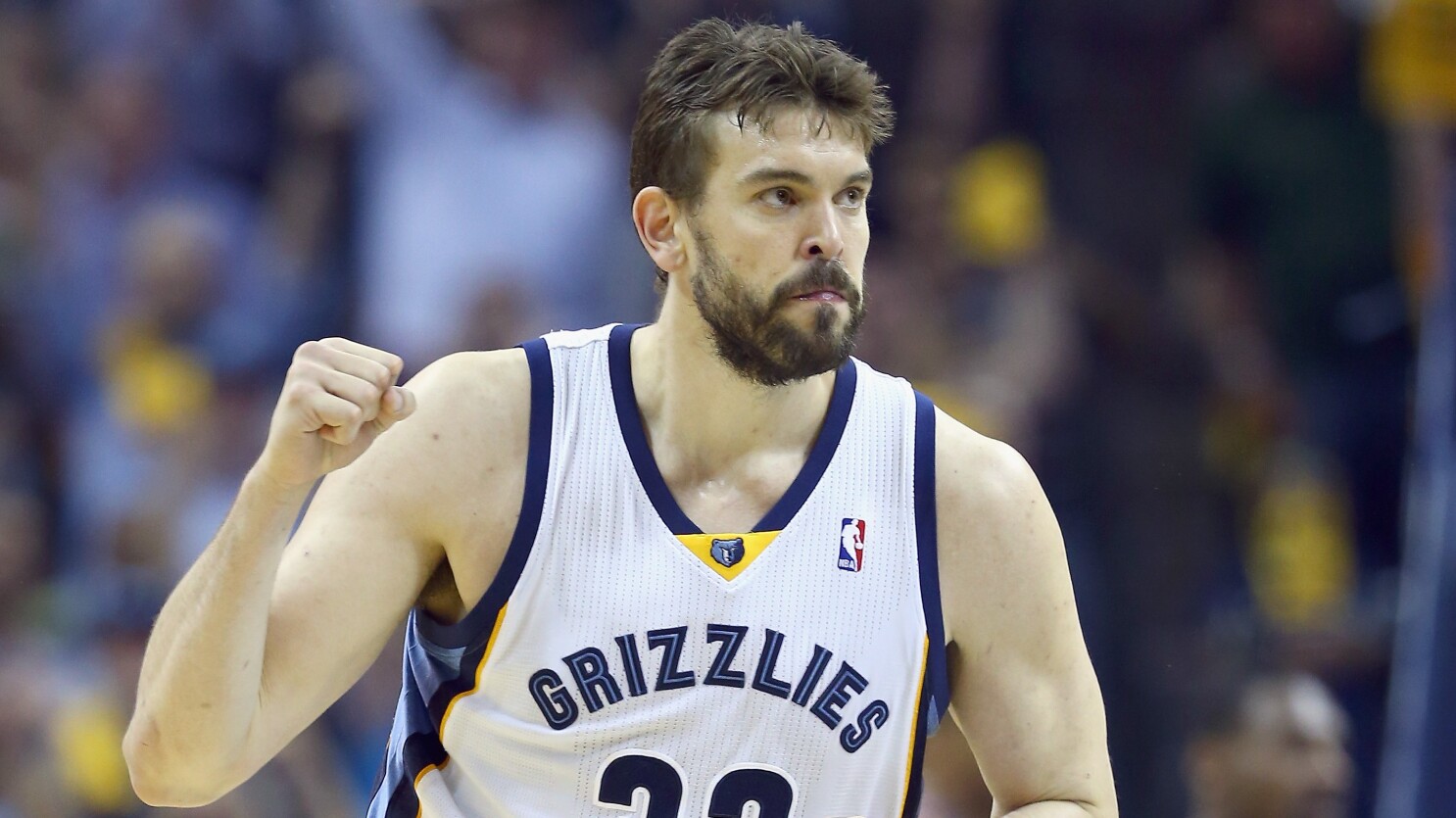
Marc Gasol, AKA “Big Spain”, is the foundation that lets everything on my team function without strain. In his peak years, he was the Defensive Player of the Year, anchor of the “Grit and Grind” Grizzlies, and a First Team All-NBA center in 2015—finishing ahead of a generation of Hall of Fame bigs. That’s a big deal because his role was never about volume scoring; it was about control. Memphis lived near the top of the league in defensive efficiency with him calling coverages, walling off the paint, and ending possessions with clean rebounds.
Offensively he’s the rare center who lowers the temperature. From the high post he initiates the offense, averaging 3–4 assists a night in his prime, delivering the ball exactly where cutters and shooters needed it. He doesn’t stall possessions; he organizes them. That skill set worked so well he took it to Toronto in 2019 where their defense solidified, ball movement improved, and the Raptors won the championship with him as the back-line quarterback.
Why did I pick Gasol over other great centers? Jokić provides a massive offensive baseline, but Gasol’s surgical high-post passing acts as the force multiplier that allows my primary scorers to reach their offensive ceiling. Bill Walton and Arvydas Sabonis fit the system perfectly, but both have the same problem: their peaks were too short or too physically compromised to anchor a playoff foundation.
Three All-Star selections only hint at his real value: Gasol gives me a foundation, communication, and playoff-level decision-making every possession. He’s not the star, he’s the reason the whole system works. With Gasol operating from the high post and anchoring the paint, I need a power forward who doesn’t clog the lane. I need someone who can stretch the floor to the three-point line without jeopardizing the defensive backline.
The Geometry Breaker: Dirk Nowitzki (Power Forward)
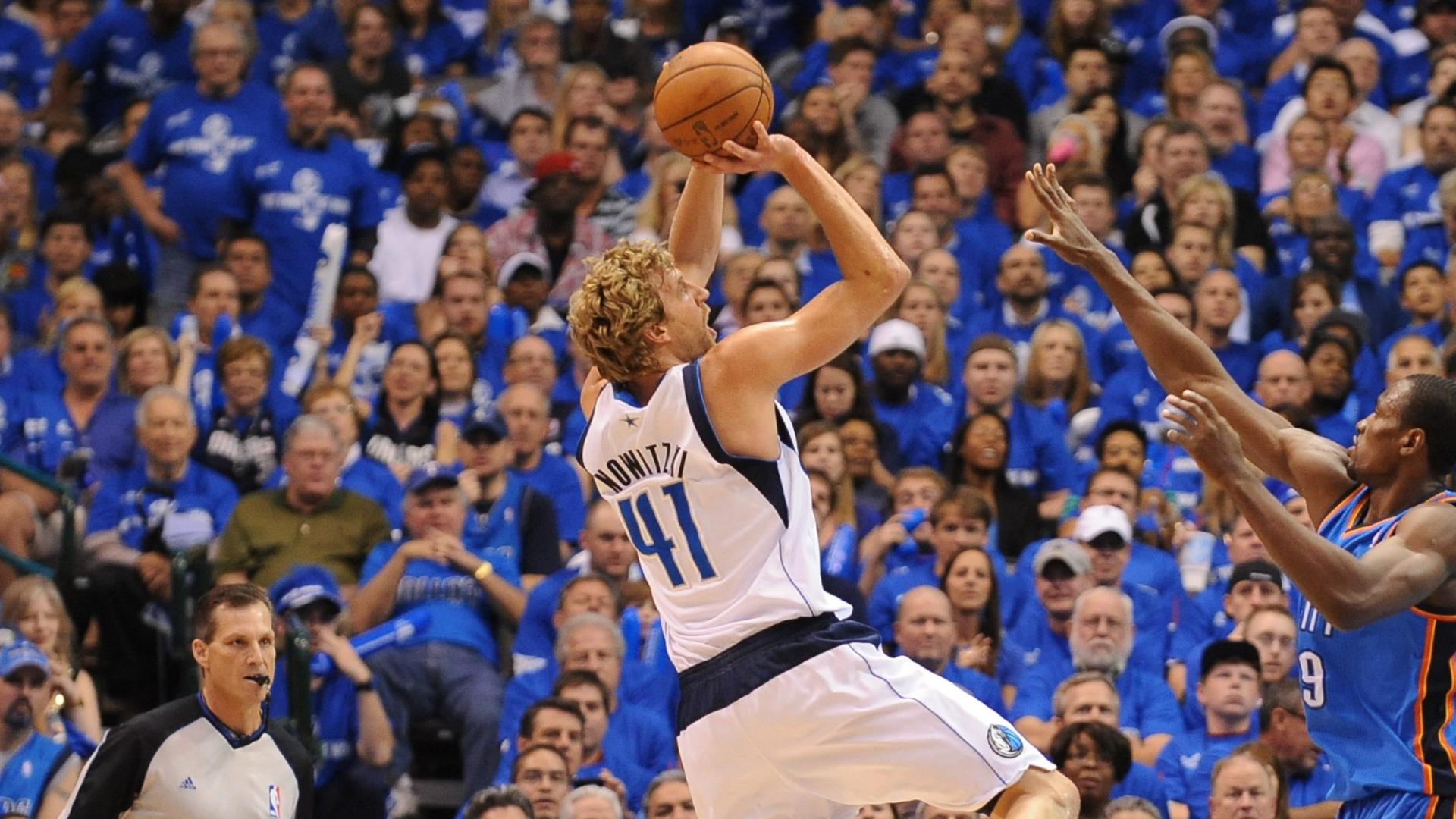
Dirk Nowitzki is the piece that bends the floor and raises the offense from functional to unsolvable. A 14-time All-Star, 2007 MVP, and 2011 champion, Dirk was the rare 7-footer to join the elite 50-40-90 club, forcing defenses into choices they just can’t win. If his defender stays home, the paint opens up for Bird and Havlicek. If they help, Dirk gets a clean look and scores. That’s the geometry he breaks.
What makes him perfect next to Marc Gasol is that he never compromises the defensive structure. Dirk doesn’t need to clog the low post. He’s perfectly comfortable in pick-and-pop space (Instead of running to the basket he pops out to the perimeter), stretching the coverage to its absolute limit while allowing Gasol to remain the back-line organizer.
In a do-or-die playoff game, Dirk is the perfect release valve. His legendary one-legged fadeaway isn’t just a highlight—it’s a late-clock solution that works across every era because no scheme has ever found a way to take it away. He is the offensive ceiling of the team, and the reason driving lanes exist in the first place.
Why Dirk over McHale? Because McHale’s low-post brilliance compresses the paint, whereas Dirk’s shooting bends the geometry and pulls elite rim protectors away from the basket. However, adding a 7-footer who lives beyond the arc creates a problem: I need a wing who can defend without rest. Someone who can chase elite scorers through endless screens and switches while Dirk holds his ground on the perimeter.
The Stamina Engine: John Havlicek (Shooting Guard)
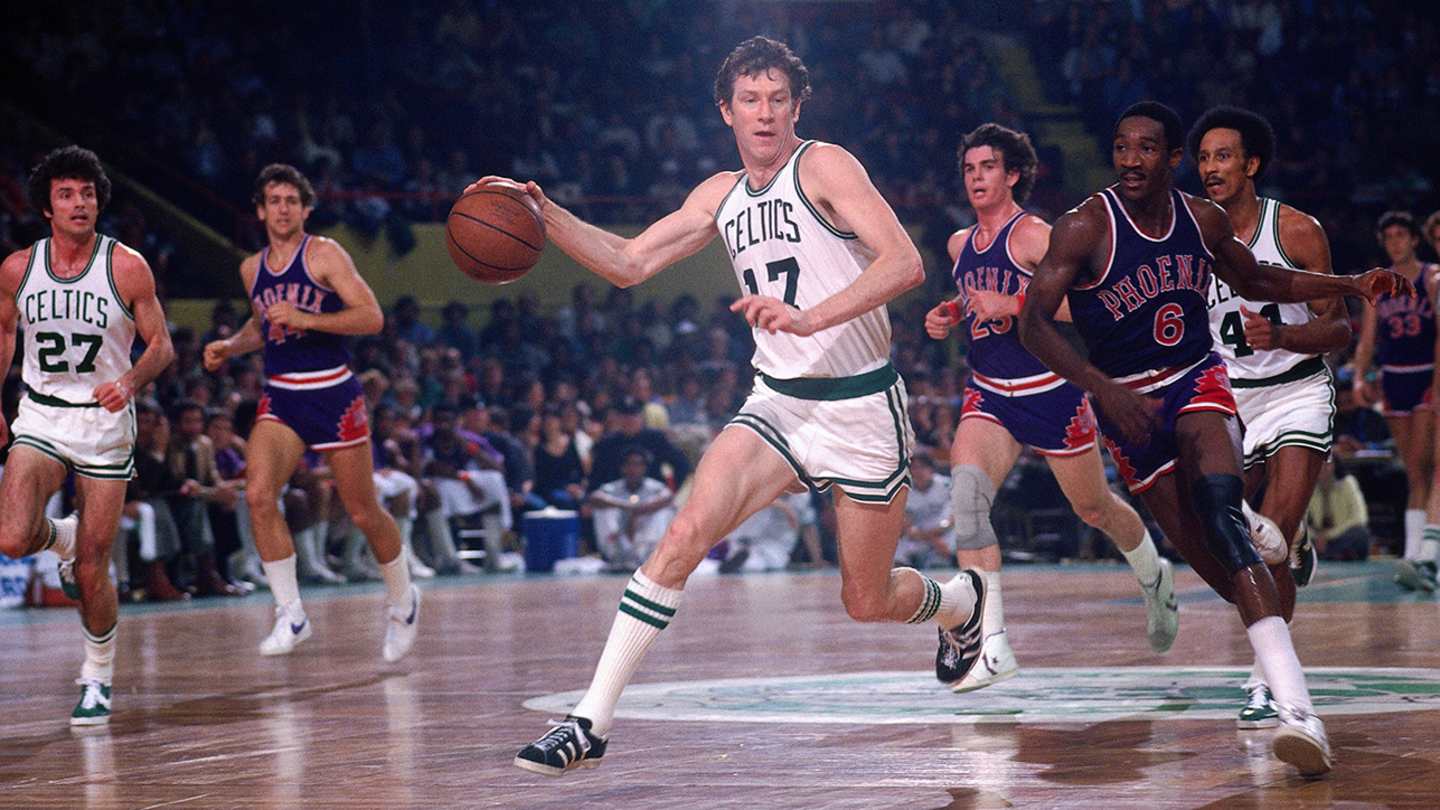
John Havlicek is the motor that allows my team to run without any trade-offs. He has 13 All-Star nods, 8 All-Defensive selections, and 8 championships, but the number that defines “Hondo” is 45.4: the average minutes he played per game during his peak seasons. He didn’t just play; he played at a higher intensity than anyone else on the floor for nearly the whole game. Bill Russell famously said, “He was the best all-around player I ever saw.”
That motor (and his legendary defense) is his role. He takes the hardest perimeter assignment, navigates every screen, and still sprints the floor as a transition finisher. He averaged 20.8 points over his career, but he never needed the offense to bend toward him; he could score within the flow. When my high-volume scorers pull the defense out of shape, Havlicek slices through the gaps, converting off-ball movement into high-percentage layups.
Defensively, John is the connective tissue. He can shadow an elite scorer for 48 minutes without help, keeping my center anchored in the paint and the rotations clean. He’s a marathon runner who comes with elite defense and perfect conditioning. He isn’t here to dominate the ball, he’s here to guarantee the whole system stays together from the opening tip to the final buzzer.
Why Havlicek over Jerry West? Havlicek’s 6’5″ length and defensive stamina make him the better two-way fit at the two, and his low-usage scoring lets our point guard direct the offense without crowding. With the frontcourt and wing locked in, next I need a guard who protects possessions and distributes without demanding touches, a floor general who makes everyone else better.
The Floor General: John Stockton (Point Guard)
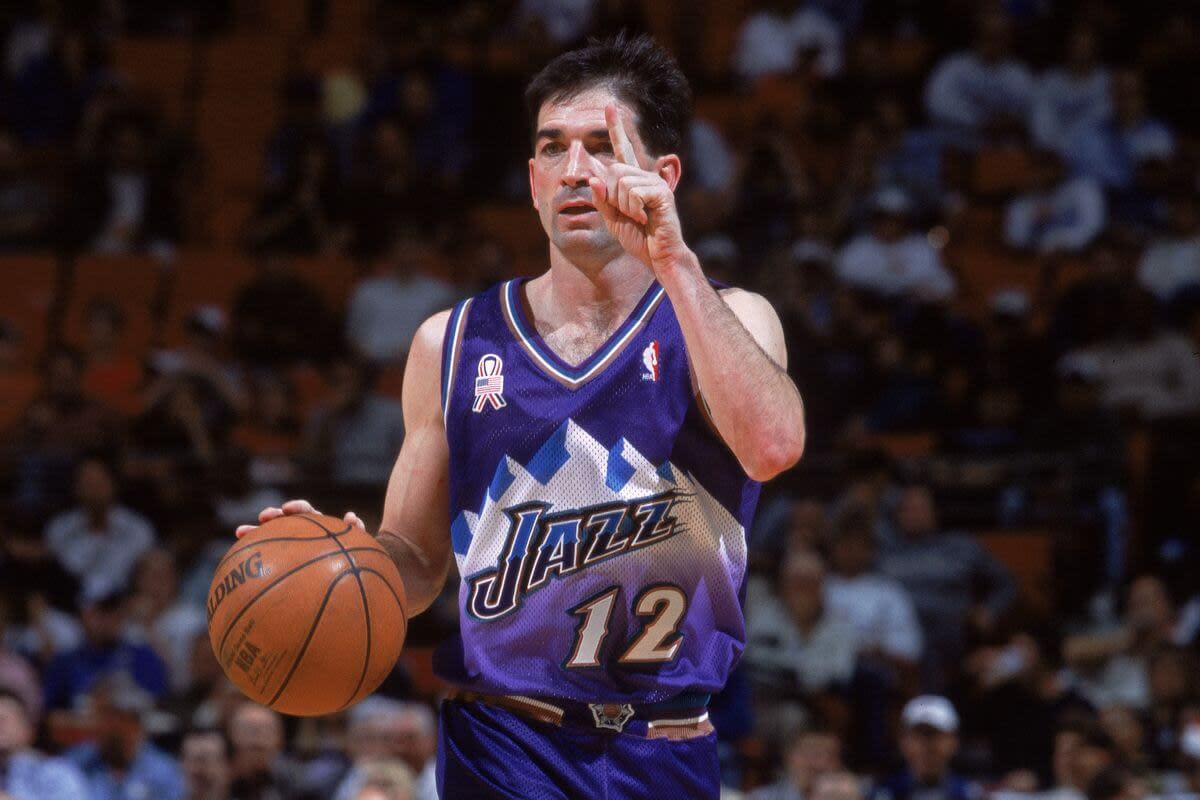
John Stockton is the possession stabilizer, the player who ensures this machine gets a clean shot every trip down. He’s the all-time leader in assists and steals, but his actual superpower is possession efficiency. He almost never gave the ball away, and in an all-time environment where empty possessions decide series, that low turnover rate is a shield.
His fit here is about surgical distribution. He initiates the offense for all four starters: precise entry passes to Gasol, pick-and-pop timing with Dirk, and hit-ahead passes to a sprinting Havlicek. This orchestration allows my small forward to operate as the ultimate finisher rather than the primary organizer. And if the defense sags, Stock was a career 51/38/82 shooter who led the league in True Shooting percentage three times. He doesn’t just pass; he punishes.
Defensively, he sets the point of attack. Physical, positionally sound, and hyper competitive, he prevents the first offensive action from collapsing the structure behind him. You don’t have to hide him, and you don’t have to feed him touches. He protects the possession economy, and that’s exactly what my lineup needs.
Why Stockton over Nash? Stockton provides the same elite playmaking while giving me the point-of-attack defense and all-time steals record that Nash can’t. Luka Dončić is an incredible offensive engine, but against all-time competition he’d be hunted defensively at a position already filled by Stockton’s two-way credibility.
All this engineering—Gasol’s IQ, Dirk’s spacing, Havlicek’s motor, Stockton’s precision—is designed for one purpose: to give the best decision-maker in the game clean looks and clear reads every possession.
The Apex: Larry Bird (Small Forward)
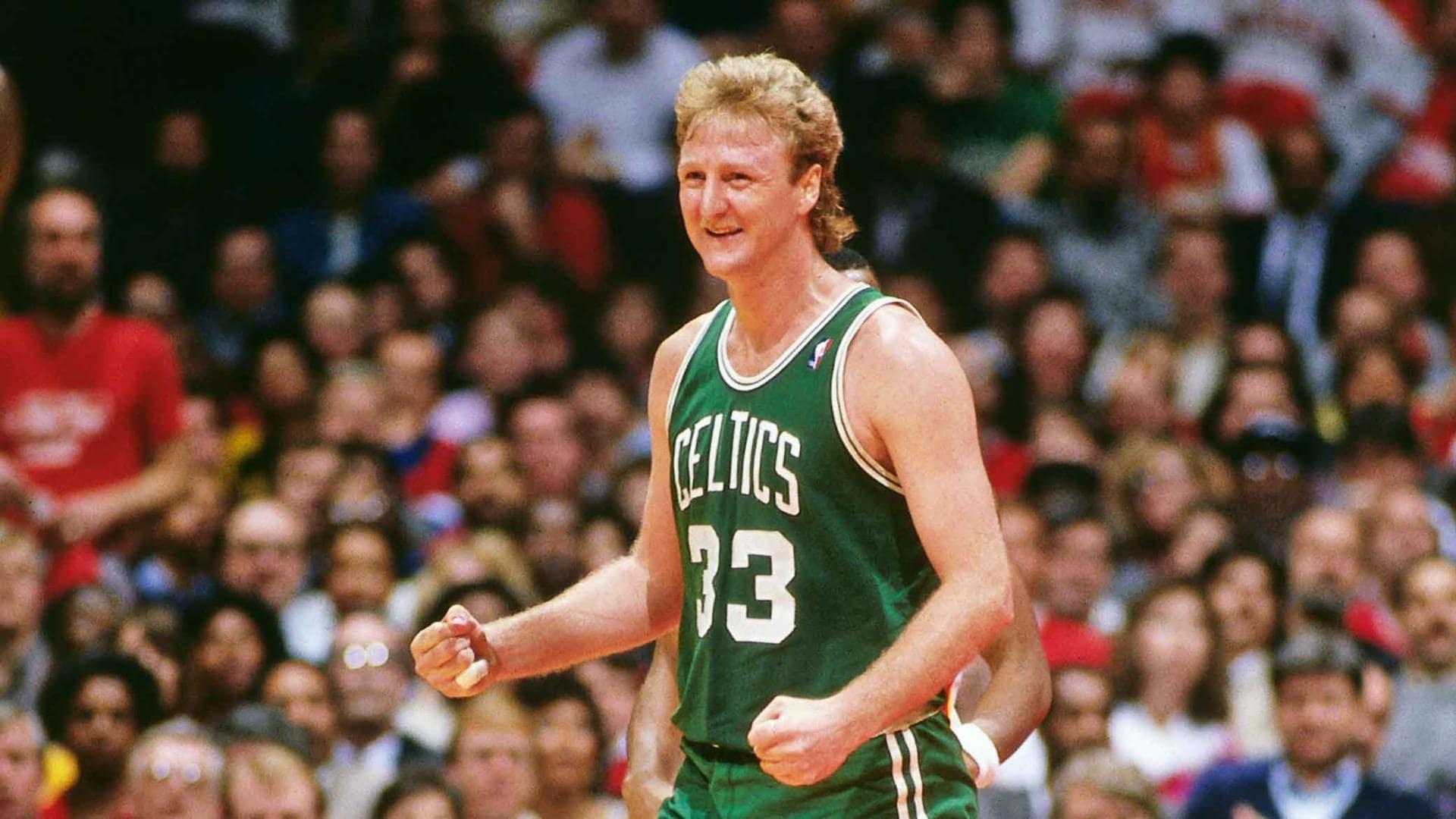
Pat Riley once said, “If I had to choose a player to take a shot to save a game, I’d choose Michael Jordan; if I had to choose a player to take a shot to save my life, I’d take Larry Bird.” Larry “Legend” Bird is the Apex, the player this entire structure is built to empower. With Gasol anchoring the back line, Dirk stretching the floor, Havlicek exhausting the wings, and Stockton delivering the ball on time, Bird gets to live in his most dangerous state: reading the game one step ahead of everyone else.
A 3-time consecutive MVP, 3-time champion, and the first to have back-to-back 50-40-90 seasons, Bird’s real value was he had the correct solution for every possession. His basketball IQ was the stuff of legend. Mismatch in the post? Punished. Help comes? An instant skip-pass to the open man. Defense scrambles? A relocation three. Averaging 24.3 points, 10 rebounds and 6.3 assists, he was a complete offensive ecosystem who didn’t need to dominate the ball to dominate the game.
In this build, Dirk’s spacing gives him clear lanes, while Stockton makes sure he receives the ball in attack mode. Even defensively, his IQ shines; he averaged 10.0 rebounds per game for his career, made three All-Defensive Teams, and posted 1.7 steals per game, thanks to his legendary trash talk. When systems break down and you need the right answer, he is the ultimate closer. Everything funnels toward his decision-making; that is why this lineup works.
But what happens when quick, athletic wings attack the rim and force Gasol away from the basket? That’s where my sixth man comes in.
The Fire Extinguisher: Andrei Kirilenko (The 6th Man)
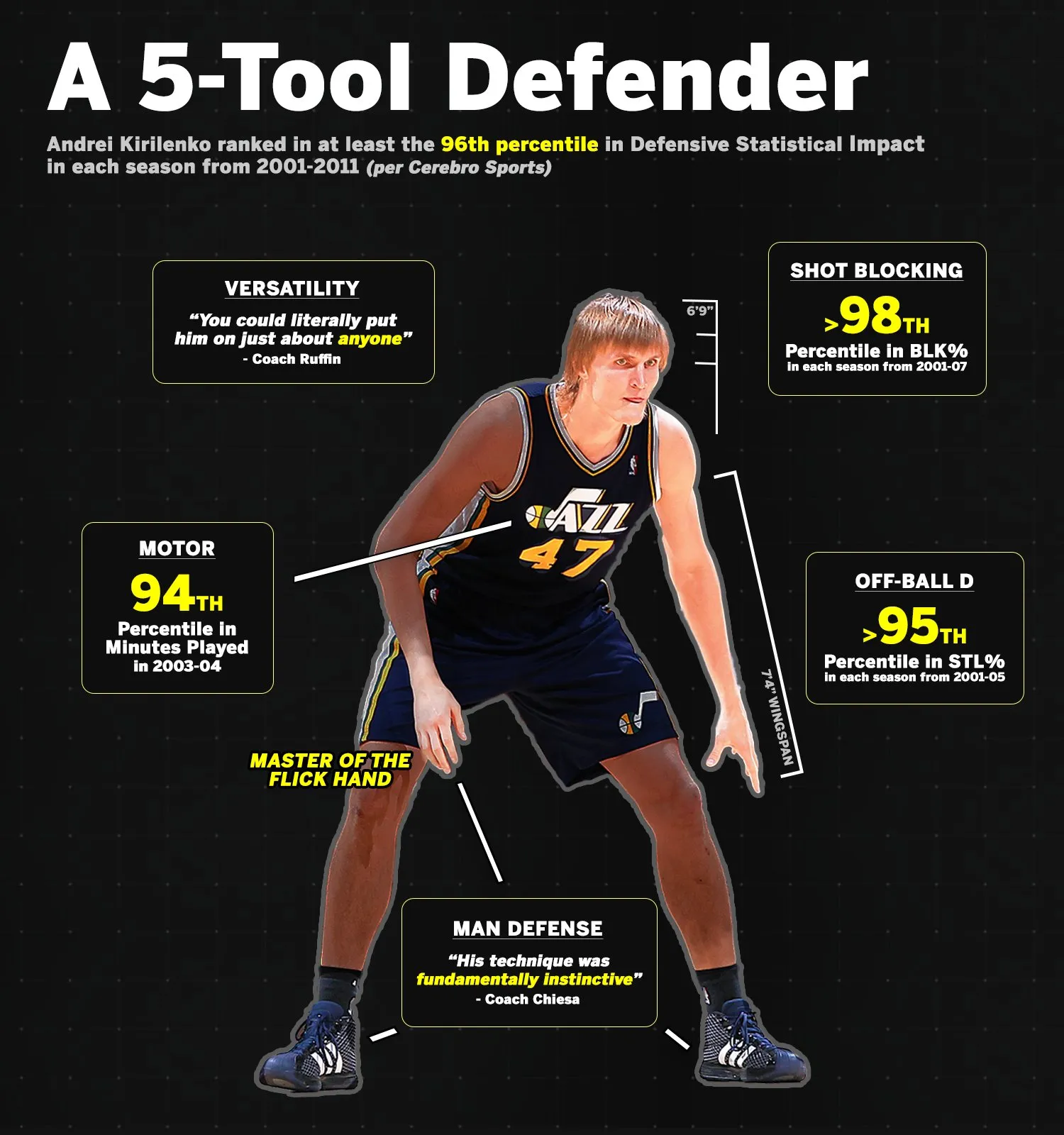
Andrei Kirilenko, the AK-47, is the piece you keep in reserve for when the game stops being played on your terms. The starters are built on structure, spacing, and control; Kirilenko is the antidote when opponents turn the game vertical. When elite wings start living in the paint, when Gasol gets pulled into repeated actions, he replaces Dirk to put a second body at the rim and restore the defensive shape.
At his peak he averaged 2.8 blocks and 1.9 steals per game—one of the few forwards ever to threaten both categories at that level—and he did it without needing the ball. In the playoffs his scoring dipped to around 10 points a night, but that’s fine for my system. Stockton and Gasol can manufacture offense while Kirilenko finishes cuts, runs the floor, and keeps the ball moving.
His real value is coverage. He can rotate from the weak side to erase a layup, switch onto a wing for a possession, or even play small-ball center for short bursts. That gives this team something it otherwise doesn’t have: a second line of vertical defense. He isn’t there to raise the ceiling, he’s there to stop the collapse—15 to 18 minutes of length, recovery speed, and disruption when the series gets volatile.
The Frictionless Engine: We Don’t Force Errors. We Exhaust Your Options.
Our edge isn’t raw force, it’s structure. Gasol and Stockton organize the floor so the ball never sticks, cutting out empty trips and blown rotations. Dirk stretches the defense to its absolute limit, creating seams that Havlicek exploits with endless, exhausting motion. Once that spacing and timing create an advantage, Bird is the apex decision-maker, picking the option that hurts you most.
Defensively, we suffocate through positioning. Gasol closes windows before you’ve decided to attack them. Stockton arrives early at the passing lane, Bird baits you into the turnover, and Havlicek never stops moving long enough to give you a clean look. We take away your first option, then your second, until the mistake feels inevitable. If you try to break the system with nonstop attacks at the rim, Kirilenko is the emergency plug: 15 to 18 minutes of weak-side erasure that restores our shape. We don’t need to overwhelm you physically. We execute with such discipline that you run out of clean solutions before the clock expires.
They’re not unbeatable, but I think they are as good as a bunch of White guys can get! Think I’m wrong? Let’s hear it below.